We partner with our neurodiverse community to provide trauma-informed and strengths-based counseling services.

Training and Workshops
We believe continuing education should not be limited by finances. To support accessibility, we offer two self-defined financial-need coupons:
half — 50% off
ndaz — 100% off
You are welcome to use these codes at any time. We do not monitor, verify, or question their use. You get to define your own financial need. Our goal is to make these trainings fully accessible so that cost is never a barrier to learning. All of our self-paced courses are listed below and can also be found here.
If you are interested in contributing to our training catalog, check out our request for proposals here.
Self-Paced Courses
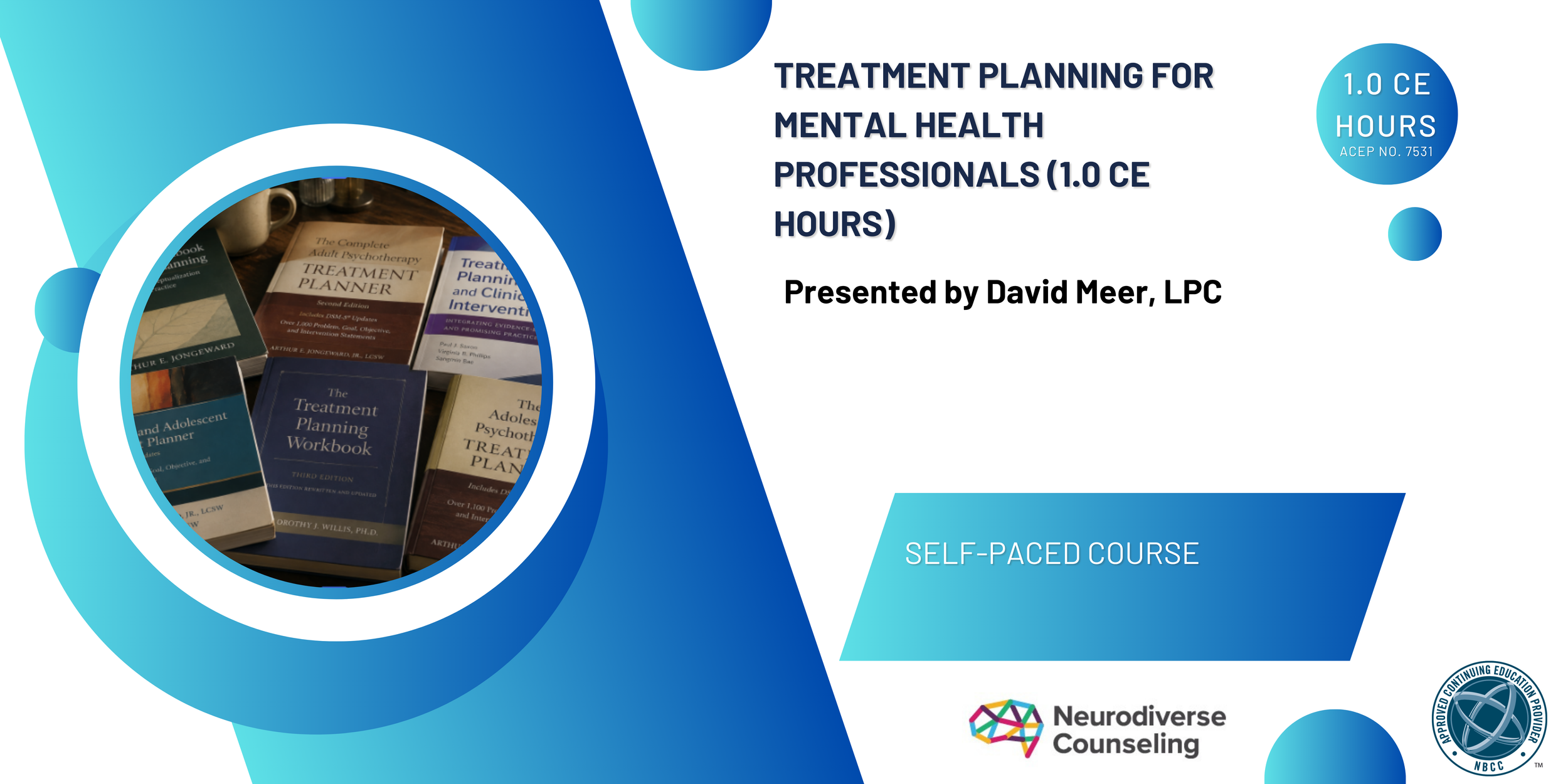
Treatment Planning for Mental Health Professionals
This course is designed to help clinicians develop treatment plans that are clinically meaningful, collaborative, and useful in actual practice. Treatment planning is often approached as a documentation requirement—something completed for compliance, insurance, or the medical record—but a well-developed treatment plan can also provide a flexible framework for understanding where therapy is going, why particular interventions are being used, and how we might recognize meaningful progress.
Drawing from clinical practice, documentation standards, and contemporary approaches to psychotherapy, this course examines both the purpose and limitations of traditional treatment planning. We’ll explore how to identify presenting concerns, develop broad therapeutic goals and useful objectives, connect interventions to those goals, and identify meaningful indicators of progress without reducing therapy to rigid checklists or arbitrary measures. We’ll also consider how treatment plans can communicate medical necessity while remaining strengths-based, individualized, and responsive to the client’s lived experience.
Throughout the course, we’ll challenge some common assumptions about what makes a treatment plan “good,” including the idea that every goal must fit neatly into a SMART framework or that meaningful therapeutic change can always be captured through standardized measures. Instead, we’ll consider multiple ways progress can become visible—including changes in functioning, skill development, participation in valued activities, client self-report, standardized measures, and other forms of clinical evidence. Particular attention will be given to creating plans that remain compatible with neurodiversity-affirming and process-based approaches to therapy.
By the end of this training, you’ll have a practical framework for developing treatment plans that satisfy documentation expectations while still reflecting the complexity of psychotherapy. Rather than treating the treatment plan as paperwork that exists separately from therapy, you’ll learn to use it as a living clinical document—one that communicates the direction of treatment, supports continuity of care, and evolves alongside the client and the therapeutic process.
Learning Objectives
1. Describe the purpose of a treatment plan and its role in clinical documentation.
2. Develop treatment plans that meet board and insurance requirements.
3. Write meaningful goals, objectives, and service recommendations.
4. Document medical necessity using a neurodiversity-affirming approach.
5. Identify multiple methods for measuring treatment progress.
HIPAA Privacy and Security Training for Mental Health Professionals
This course is designed to help clinicians understand how to protect client information in a modern clinical environment, where documentation, communication, and care increasingly rely on electronic systems. In mental health, clients share deeply personal and vulnerable information, and protecting that information is both an ethical obligation and a legal requirement.
Drawing from federal regulations, state confidentiality law, and contemporary clinical practice, this course translates complex legal and technical requirements into practical, usable safeguards. We’ll examine how the Privacy Rule, Security Rule, and Breach Notification Rule function as an integrated framework for protecting Protected Health Information, and how these standards apply to everyday clinical decisions, communication tools, and electronic systems. HIPAA establishes national standards governing when information may be shared and how electronic data must be protected, while requiring practices to implement administrative, physical, and technical safeguards to ensure confidentiality and prevent unauthorized access.
We’ll also explore privacy as an evolving challenge within modern mental health care. As documentation, telehealth, and communication increasingly move into digital environments, clinicians must navigate risks that extend beyond traditional confidentiality concerns, including cybersecurity threats, electronic access controls, and data breaches. This course reframes HIPAA not as a bureaucratic obstacle, but as a living structure designed to preserve trust, autonomy, and ethical care in an increasingly interconnected world.
By the end of this training, you’ll have a deeper understanding of how privacy and security function within contemporary clinical practice, how to confidently apply HIPAA standards in real-world situations, and how to safeguard both your clients and your professional integrity. Rather than memorizing rules, you’ll develop a practical framework for making thoughtful, ethical decisions that protect confidentiality while supporting meaningful therapeutic work.
Learning Objectives
1. Identify the three primary HIPAA rules (Privacy, Security, and Breach Notification) and their purposes in protecting client information.
2. Differentiate between administrative, physical, and technical safeguards under the HIPAA Security Rule.
3. Describe how Protected Health Information (PHI) and Electronic PHI (ePHI) must be handled according to federal regulations and practice policy.
4. Apply secure communication practices for transmitting PHI via email, phone, and telehealth platforms.
5. Recognize potential security threats (e.g., phishing, social engineering, data breaches)
6. Evaluate scenarios involving privacy or security risks and determine appropriate preventive or corrective actions.
Anarchy in Clinical Supervision
Summary
This training invites supervisors and clinicians to step beyond inherited hierarchies and reimagine supervision as a relational, collaborative, and liberatory practice. Together, we will examine how power, institutional norms, and unexamined assumptions shape supervisory relationships, often in ways that reproduce fear, compliance, and burnout rather than growth.
Drawing from anarchist philosophy, critical theory, multicultural supervision research, and contemporary models of reflective practice, this course translates complex political and relational ideas into practical supervisory skills. We’ll explore how authority operates in supervision, how systemic and neurotypical biases become embedded in competency standards, and how bureaucratic mandates quietly shift supervision from mentorship to surveillance. This training will guide you in decentralizing power while maintaining clear ethical and legal boundaries.
We’ll also explore supervision as a corrective and healing experience. Many clinicians carry relational wounds from prior training environments shaped by hierarchy and control. This course offers an alternative vision: supervision as a secure base, mutual aid, and shared decision-making. By the end, you’ll have a deeper understanding of how power functions in supervisory systems, how to foster autonomy without abandoning accountability, and how to cultivate supervisory relationships grounded in trust, creativity, and collective growth.
Learning Objectives
1. Deconstruct biases embedded in professional counseling supervision.
2. Challenge traditional models of supervision in professional counseling, rooted in hierarchical and bureaucratic structures.
3. Explore how to decentralize power to build a collaborative supervisory relationship that fosters trust and autonomy, while maintaining compliance with professional standards.
4. Redefine the purpose of supervision as a tool for mutual growth, empowerment, and support.
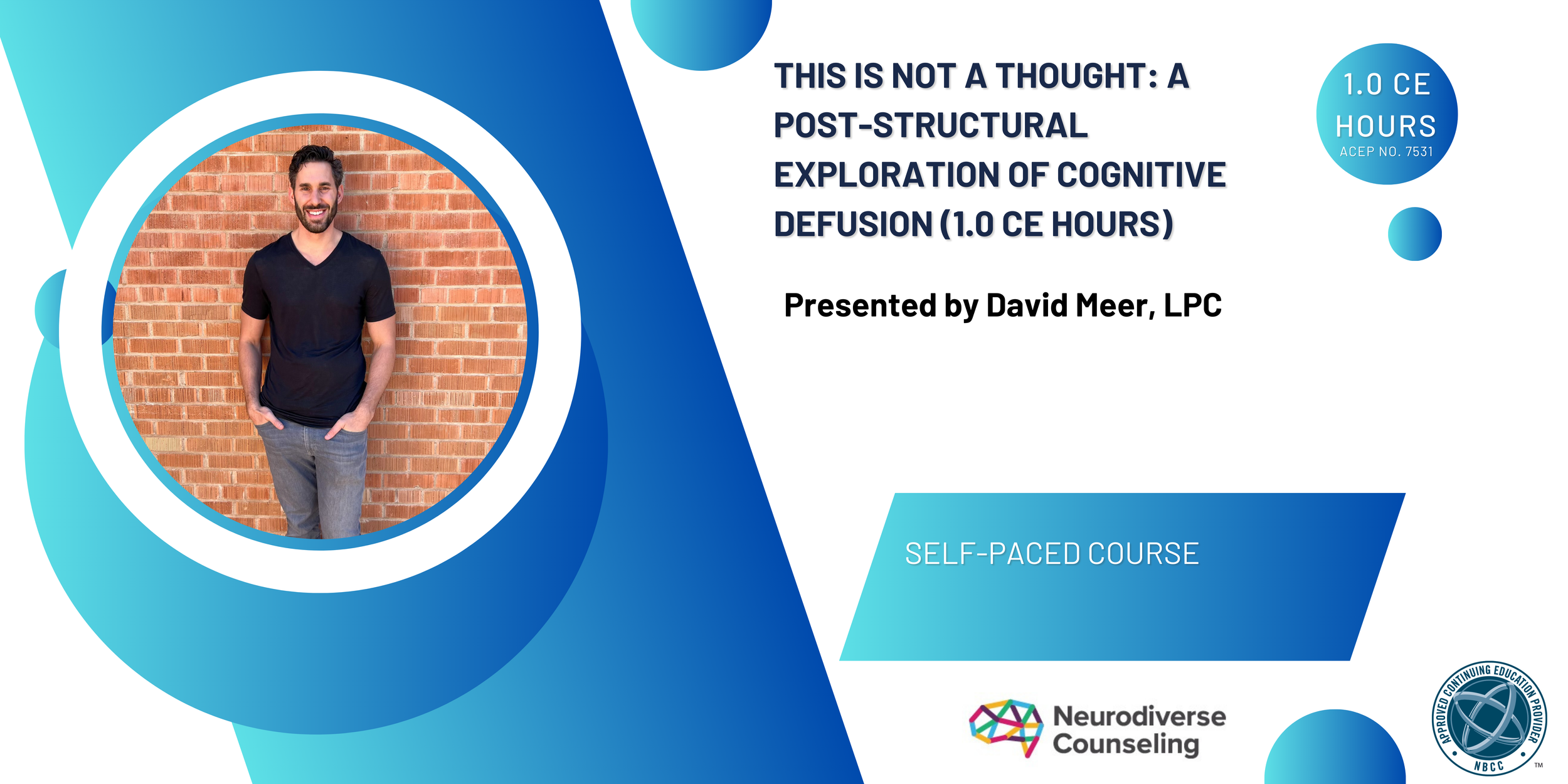
This Is Not a Thought: A Post-Structural Exploration of Cognitive Defusion
Summary
This training invites therapists to step beyond the limits of traditional cognitive models and explore how language, culture, and power shape the inner worlds of our clients. You’ll learn to recognize how thoughts function—not as truths to be corrected, but as linguistic events that can entangle, constrain, or liberate.
Drawing from Acceptance and Commitment Therapy, Relational Frame Theory, and post-structural thinkers like Foucault and Deleuze, this course translates complex philosophical ideas into practical clinical skills. Together, we’ll examine how cognitive fusion forms through cultural memes, relational frames, internalized norms, and the “internal panopticon” of self-monitoring. Through case examples, metaphors, and experiential exercises, you’ll learn how to help clients step back from rigid narratives and move toward values-aligned action. We’ll also explore the ethical dimension of cognitive defusion—how shifting our relationship to language can reduce shame, honor lived experience, and validate sociocultural realities that traditional CBT often overlooks. By the end, you’ll have a deeper understanding of how thoughts operate, how suffering is constructed, and how defusion can support clients in building lives that are flexible, meaningful, and self-authored.
Learning Objectives
1. Critique the limitations of traditional CBT in addressing sociocultural and identity-based experiences of distress.
2. Analyze the implications of cognitive fusion through a sociocultural and post-structural lens, including its relationship to power, identity, and internalized norms.
3. Define cognitive fusion and defusion within the framework of Acceptance and Commitment Therapy (ACT).
4. Identify common clinical examples of fused thinking and explain how fusion contributes to psychological suffering.
5. Describe how language, cultural memes, and relational frames shape internal narratives and reinforce identity-based fusion.
6. Create original metaphors for cognitive defusion to use in clinical practice.
Deconstructing Toward Neurodiversity
Summary
Neurodiversity is a portmanteau first publicized by activist Judy Singer and columnist Harvey Blume, which can be broken down into its components of “neuro,” referring to the nervous system, and “diversity,” which refers to the variety and differences of things. Hence, neurodiversity speaks to the variation in neurological functioning in humans. The neurodiversity movement urges us to recognize neural and biological differences, to understand that not every brain works like yours, and that other people may experience the world much differently from you. There are different ways of perceiving the world, capacities to reason and think critically, and sensitivities to environmental stimuli. As providers, it is important for us to take perspective and decenter from dominant normed narratives.
The purpose of this session is to discuss the history of the neurodiversity movement and neurodivergent culture so mental health providers, educators, and community members can effectively support neurodivergent people and build neuroinclusive environments. The information in this training may be considered a precursor to becoming a neurodiversity affirming provider.
Objectives
1. Understand the Concept of Neurodiversity
Define neurodiversity and explain its significance in the context of biological and cognitive diversity.
Discuss how neurodiversity fits within the broader framework of human biodiversity.
2. Critique Conventional Notions of Normalcy
Analyze the historical and societal constructions of "normal" and "average" in mental health.
Explore the impact of these constructs on societal attitudes and practices towards neurodivergent people.
3. Explore the Evolution of Neurodiversity as a Paradigm
Trace the history of the neurodiversity movement and its key milestones.
Describe the core principles of the neurodiversity paradigm and its implications for social inclusion and policy.
4. Promote Neurodiversity-Affirming Practices
Examine best practices for affirming neurodiversity in therapeutic, educational, and workplace settings.
Develop strategies for supporting neurodivergent individuals by leveraging their unique strengths and addressing their specific needs.
Ethical Insights from Arizona Board Cases: Best Practices for Therapists
Summary
Ethics, like law, is more than a set of rules—it is a framework that shapes how we serve and safeguard our clients. In Arizona, professional practice is governed by three layers: statutes enacted by the legislature, rules created by the Arizona Board of Behavioral Health Examiners (AZBBHE), and the ethical codes of our professional associations. Together, these establish the standards by which therapists are held accountable.\
This course uses real disciplinary cases to illustrate how these standards come to life in practice. Reviewing board actions helps us recognize not only what went wrong, but also what systems and pressures contribute to ethical lapses. The goal is not punishment, but growth—learning how to strengthen our practice, reduce risk, and create safer environments for clients.
The purpose of this session is to examine the most common ethical pitfalls therapists face in Arizona—such as documentation errors, practicing beyond scope of competence, conflicts of interest, billing issues, and breaches of confidentiality—and to translate them into actionable best practices. By learning from peers’ mistakes, participants can approach their own work with greater clarity, compassion, and confidence.
Objectives
1. Understand common ethical violations and their implications.
2. Examine real-world cases to identify key ethical issues and learn from them.
3. Integrate best practices to ensure compliance with legal and ethical standards.
Documentation for Compliance
Summary
This course is designed to help Arizona therapists build confident, compliant, and affirming documentation habits that meet state, federal, and insurance standards. You’ll learn how to write clear, defensible records that protect your clients, your license, and your livelihood.
Through practical examples and guidance drawn from Arizona Board rules, insurance payer manuals, and Medicare standards, this course translates complex requirements into actionable clinical skills. You’ll explore how to demonstrate medical necessity, structure assessments and treatment plans, and strengthen progress notes to exceed audit expectations.
We’ll also address the ethical dimension of documentation, including how accurate, inclusive language safeguards clients’ dignity and supports equitable care. By the end, you’ll have the tools and confidence to create records that are not only compliant but clinically meaningful, affirming, and reflective of professional excellence.
Objectives
1. Document in compliance with Arizona Board rules and insurance payer requirements.
2. Write assessments, treatment plans, progress notes, and discharge summaries that demonstrate medical necessity.
3. Avoid common documentation errors that lead to audit failures or board complaints.
Live Training Course Catalogue
How to Be a Neurodiversity Affirming Therapist
Summary
Affirming therapists recognize that neurodiversity is part of the natural and vital variation of neurological structure and function that exists amongst human beings. They validate and advocate for marginalized people by developing their awareness of lived experiences and creating nonjudgmental, brave spaces that facilitate neurodivergent acceptance and expression. Affirming therapists are openly engaged with their inner curiosity, question assumptions, and provide outspoken, informed critiques of the status quo in their communities.
The purpose of this session is to describe an affirming theoretical framework for therapeutic practice. We explore behavior from a holistic lens, integrating myriad sciences and levels of analysis to inform our understanding of neurodiversity and show how to build a clinical practice based on therapeutic processes rather than treatment strategies for syndromes.
Learning Objectives
Holistic and Inclusive Understanding
Participants will understand how neurodivergence intersects with other marginalized identities.
Strengths-Based Approaches and Goal Setting
Participants will recognize and leverage the strengths of neurodivergent individuals while setting personalized therapeutic goals that respect their unique neurological profiles.
Empowerment through Self-Advocacy
Participants will gain skills to empower neurodivergent individuals to articulate their needs, assert boundaries, and connect with supportive communities.
Adaptive Practices and Advocacy for Systemic Change
Participants will reflect on practices that adapt to the needs of neurodivergent clients and advocate for systemic changes that promote inclusion and understanding in various environments.
Autistic Masking
Summary
Masking is the incongruence between an individual’s external presentation and internal states. Therapeutic modalities often encourage masking of autistic characteristics in social situations under the pretense that it will help build, manage, and maintain relationships. Autistic people are taught to navigate social expectations by evaluating their internal states and camouflaging intense emotional responses, intentionally disrupting the mind-body connection and leading to increased stress, anxiety, and depression.
Polyvagal theory and endocrinology provide a lens through which we can see the biological and psychological impact of prolonged stress responses. Learned helplessness developed from years of masking may lead to a loss of sense of self, authenticity, and autonomy. It is hypothesized that this may contribute to permeable boundaries, leading to a higher incidence of abuse toward autistic people.
This session examines the biological and psychological impact of masking. We will also discuss more adaptive forms of functioning in social environments that support the needs of autistic individuals.
Objectives
Define and describe masking
Define and describe masking and how it relates to autism.
Examine lived experiences and emerging research related to masking.
Identify ablest social skills goals.
Discuss the impact of the Double Empathy Problem on neurodiverse relationships.
Review the overlap and high incidence of masking in women.
Reflect on the impact of masking on self-advocacy and assertion of needs.
Understand the psychological impact of masking and develop strategies to support autistic people.
Define and recognize autistic burnout and its symptoms.
Understand the etiology of autistic burnout and how it differs from clinical depression.
Define and describe learned helplessness and explain how it relates to societal pressures on autistic people
Collaborate with autistic people to develop individualized self-management strategies.
Implement holistic strategies that aid in minimizing autistic burnout.
Professional Speaker Fees
$1200 for 90-minute in-person or virtual session.
Previous Workshops

Neurodiverse Counseling Services has been approved by NBCC as an Approved Continuing Education Provider, ACEP No. 7531. Programs that do not qualify for NBCC credit are clearly identified. Neurodiverse Counseling Services is solely responsible for all aspects of the programs.

Neurodiverse Counseling Services has been approved by NBCC as an Approved Continuing Education Provider, ACEP No. 7531. Programs that do not qualify for NBCC credit are clearly identified. Neurodiverse Counseling Services is solely responsible for all aspects of the programs.

*Neurodiverse Counseling Services has been approved by NBCC as an Approved Continuing Education Provider, ACEP No. 7531. Programs that do not qualify for NBCC credit are clearly identified. Neurodiverse Counseling Services is solely responsible for all aspects of the programs.

Neurodiverse Counseling Services has been approved by NBCC as an Approved Continuing Education Provider, ACEP No. 7531. Programs that do not qualify for NBCC credit are clearly identified. Neurodiverse Counseling Services is solely responsible for all aspects of the programs.

Empowering Neurodivergent Strengths has been approved by NBCC for NBCC credit. Neurodiverse Counseling Services is solely responsible for all aspects of the program. NBCC Approval No. SP-4293

Join us for a free online training in Neurodiversity Affirming Supervision on June 9th from 11:00am to 2:00pm PST (This event is sold out. Please sign up below to receive updates for upcoming events).


Neurodiversity is a portmanteau first coined by activist Judy Singer and columnist Harvey Blume, which can be broken down into its components of “neuro,” referring to the nervous system, and “diversity,” which refers to the variety and differences of things. Hence, neurodiversity speaks to the variation in neurological functioning in humans. The neurodiversity movement urges us to recognize neural and biological differences, to understand that not every brain works like yours, and that other people may experience the world much differently from you. There are different ways of perceiving the world, capacities to reason and think critically, and sensitivities to environmental stimuli. As providers, it is important for us to take perspective and decenter from dominant normed narratives. The purpose of this webinar is to discuss the history of the neurodiversity movement and neurodivergent culture so mental health providers, educators, and community members can effectively support neurodivergent people and build neuroinclusive environments. The information in this training may considered a precursor to becoming a neurodiversity affirming provider.
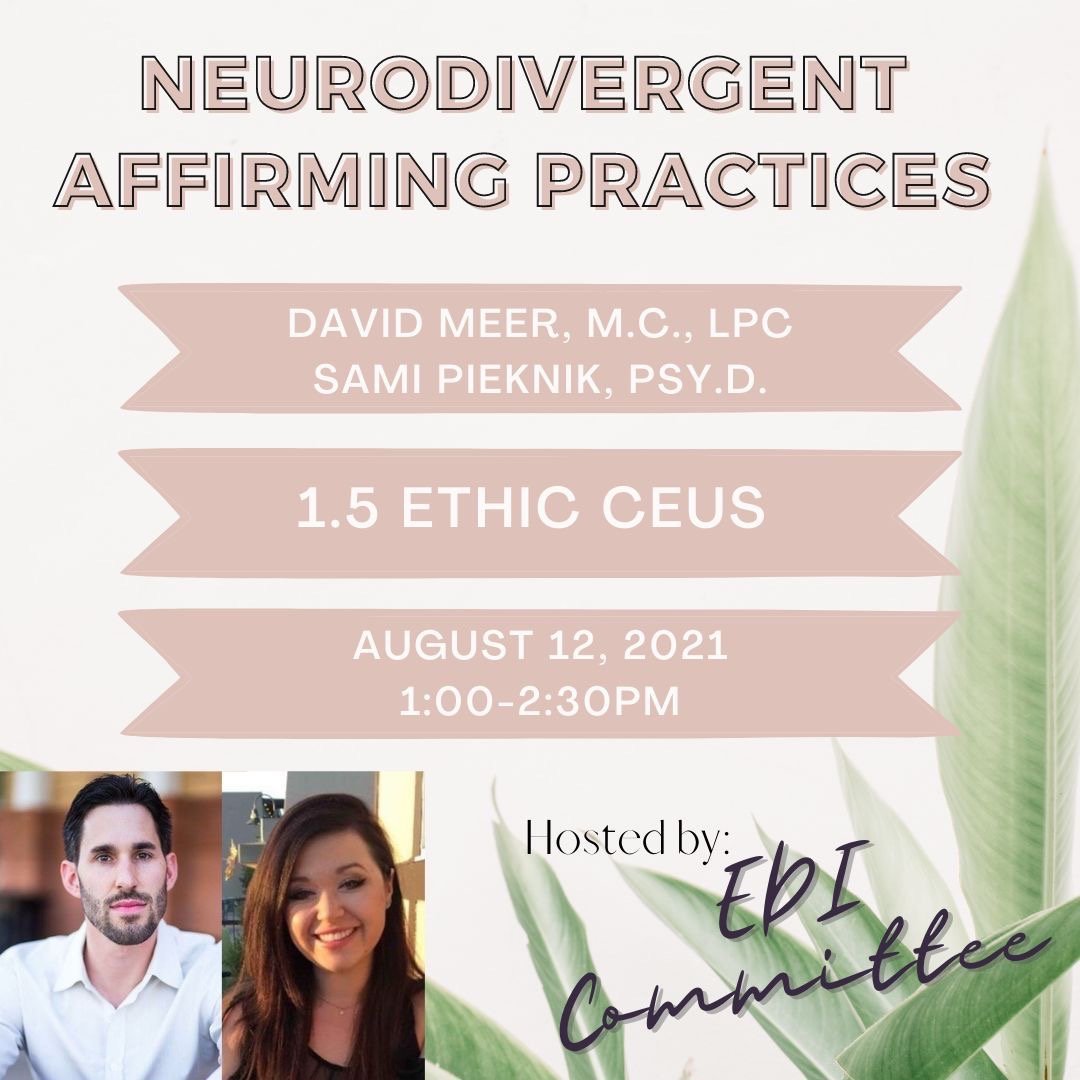
For additional information, please contact us using the form below
*If a participant or potential participant would like to express concern about their experience from a workshop with Neurodiverse Counseling Services, David Meer, or Dr. Samantha Pieknik, please contact us via email at admin@neurodiversecounseling services or via phone at 480.531.1076. We consider all complaints on a case-by-case basis and will work with you to come to an amicable resolution.
